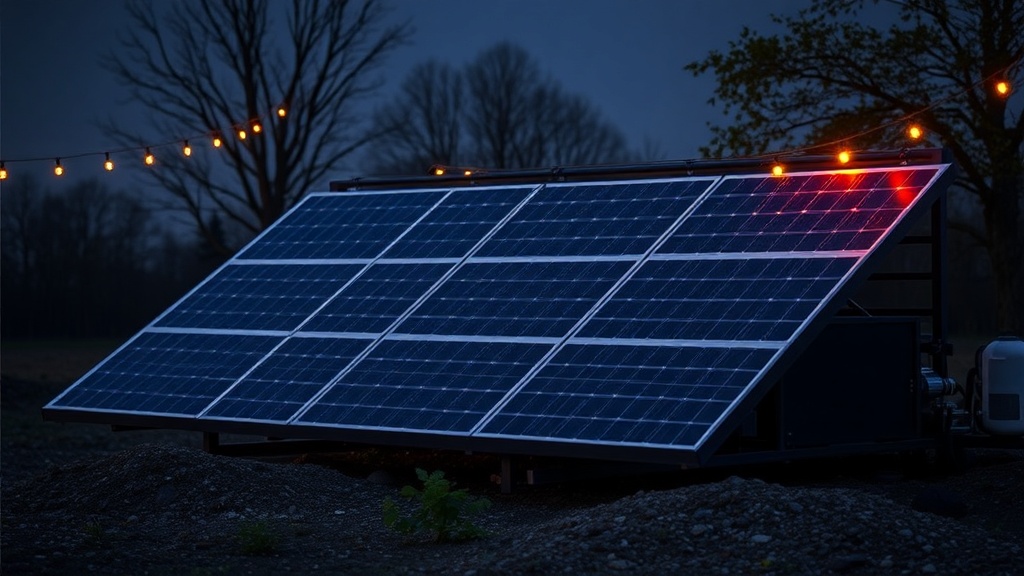
Smart Solar Setups for Off-Grid Power Management

Why Solar Power Matters for Off-Grid Camping
According to data from the National Renewable Energy Laboratory, solar radiation levels can vary wildly even within the same state, meaning your setup needs to be adaptable. Relying on a single, fixed solar panel often leads to frustration when the sun dips behind a canopy or a mountain. This post looks at how to build a dependable solar system that keeps your van or tent running without constant anxiety about your battery levels. We're covering the practicalities of panel types, charge controllers, and why your angle matters more than you think.
When you're out in the middle distance—away from any paved roads or electrical hookups—your power becomes your most valuable resource. You aren't just talking about charging a phone; you're talking about running a portable fridge, a fan, or even a laptop. Without a thoughtful approach to solar, you might find yourself sitting in the dark or, worse, watching your food spoil because your battery died overnight. It's a delicate balance of input and consumption.
What type of solar panel is best for a van or RV?
Choosing the right panel depends entirely on how much space you have and how much weight you can carry. There are three main types you'll encounter in the wild:
- Rigid Monocrystalline Panels: These are the heavy hitters. They're durable, highly efficient, and usually mounted permanently to the roof of a vehicle or a campsite structure. They look professional, but they aren't exactly portable.
- Flexible Panels: These are great if you're working with a curved surface, like the roof of a van. They're lightweight and easy to stow, but they often don't last as long as rigid ones.
- Portable Folding Panels: If you're a car camper rather than a van dweller, these are your best friend. You can set them up in a sunny spot and tuck them away when it's time to move.
Most people I talk to start with a portable setup, but as you stay on the road longer, you'll likely want something more permanent. If you want to check the current efficiency ratings for different panel technologies, the National Renewable Energy Laboratory offers deep technical insights that are worth a look.
How much solar wattage do I actually need?
This is the question that keeps many beginners awake at night. The short answer is: it depends on your load. A single 100-watt panel might be enough to keep a few LED lights and a phone charger going, but it won't touch a portable fridge and a fan. You need to do some quick math before you head out. Look at the wattage of every device you plan to use. If your fridge pulls 40 watts and you run it for 24 hours, you're looking at a significant chunk of energy. To ensure you're not just draining your battery faster than you can fill it, you should aim for a system that produces at least 20-30% more than your daily consumption. This provides a safety net for cloudy days or unexpected rain.
| Device Type | Estimated Daily Watt-Hours | Recommended Solar Input |
|---|---|---|
| Phone & Tablet | 15-30 Wh | 50W Panel |
| Portable Fridge | 400-600 Wh | 200W+ Panel |
| LED Lighting | 20-50 Wh | 50W Panel |
| Laptop | 100-200 Wh | 150W+ Panel |
Don't forget that your battery capacity is just as important as the panel itself. A high-wattage panel is useless if your battery can't store the energy or if your charge controller is poorly matched to your hardware. It's a closed loop—one part affects the other directly.
Can I use a solar generator or a DIY battery bank?
This is a divide in the camping community. On one hand, you have "all-in-one" portable power stations (often called solar generators). These are incredibly convenient—you plug your solar panel into the station, and you're done. There's no wiring, no complex assembly, and they are very easy to move around. On the other hand, there's the DIY route involving lithium batteries, MPPT controllers, and custom-wired panels. The DIY route is more expensive upfront and takes more time, but it's far more modular. If a part breaks, you can replace just that part. With a portable power station, if the internal battery fails, the whole unit is essentially a paperweight.
If you're just starting out, a portable power station is a great way to test the waters. However, if you're planning on living in your van for months, you'll likely find the limitations of those all-in-one units frustrating. You can learn more about the electrical requirements of different systems through the U.S. Department of Energy resources, which explain how electrical loads work in a broader sense.
One thing I've learned the hard way: the angle of your panels is everything. A panel lying flat on the ground or a van roof might only get a fraction of its potential energy compared to one tilted toward the sun. If you're using portable panels, don't be afraid to move them throughout the day. It's a bit of a chore, but it makes a massive difference in how much juice you actually collect. A little bit of movement can be the difference between a dead battery at 2 AM and a full charge by sunset.